Thursday, 17 March 2016

How did the parish of Mildenhall in Suffolk care for its poor parishioners in the first half of the 16th century?

One of the large carved figures of angels with outstretched wings which decorate the 15th-century roof of St Mary's church, Mildenhall, Suffolk.
***

In answering this question the main printed primary source will be Judith Middleton-Stewart’s book containing the churchwardens’ accounts for Mildenhall for the first half of the 16th century.

Judith Middleton-Stewart, ed., ‘Records of the Churchwardens of Mildenhall: Collections, 1446-1454, Accounts, 1503-1553’ (Suffolk Records Society, vol. 54, 2011)

Middleton-Stewart was mainly concerned to highlight changes in ecclesiastical practices within the parish culminating with the effects of government directives on the church during the reign of Edward VI. However, the concern here will be to squeeze the source material as far as possible for evidence of how the Mildenhall parishioners maintained their poor rather than how they maintained the fabric of their church.  In doing so, much use will be made of Marjorie McIntosh’s recent study of the period in her book, “Poor Relief in England 1350-1600”. The essay will begin by outlining the function of churchwardens and their accounts followed by a discussion of pre-Edwardian almshouses in Mildenhall and the role played by the local poor in pre-Reformation commemorative practices. Then the focus will move to the watershed years of 1547 to 1553 with a description of the sale of the church plate and the stores of candle wax and the relevance of this sale to the relief of the poor.  The consequences of the installation of the church poor box during this period will also be discussed. Finally, there will be some exploration of the way Mildenhall wills reveal testators’ attitudes to the poor, concluding with some general discussion of how practices changed as the local community developed more protestant sympathies.

Churchwardens’ accounts form the heart of any parish’s written history, as they are not only an account of ecclesiastical expenses, but also of much of the community’s civic life.  They were once regarded as the dreary preserve of parochial antiquarians but are now increasingly quarried for information about the social relations of parish life.

Who served as churchwardens in Mildenhall? At the beginning of the 16th century there were two churchwardens (but occasionally four) who usually served for three years.  They were chosen from among the ‘substantial men’ of the parish - well-established and respected local tradesmen and craftsmen, who possessed some wealth and standing in the community.  As the century progressed they were to develop more and more responsibility for the maintenance of the parish poor.  However, prior to the 1540s there is little evidence in the churchwardens’ accounts that they did much more than make occasional distributions of money to the poor from their general fund.  This is typical of the country as a whole where “churchwardens seem to have made little effort prior to 1547 to raise funds expressly for poor parishioners.”  In the Mildenhall accounts there is a single reference in 1505:

Item taken owte of the churche for the pore 10s

Similarly, there is a single reference in the same year to the maintenance of the local almshouse:

payd for a hundred bryckes for the almes houses chymney 1s 4d

We do not know precisely when the Mildenhall almshouse was built, though it must have been medieval in origin, but we do know that at the end of the 15th century and the beginning of the 16th century the founding of almshouses was increasing, especially in the south-east and in East Anglia, with some testators leaving property in their will as accommodation for the deserving poor.  However, the next reference in Mildenhall to local almshouses is not until 1552 with the following entries

Item for crotchets [metal hooks] and rafte for pooer almses howse 1s  4d
…
Item for medynge of the pooer menes chymnes 7s  0d
…
Item thankeng [thatching] of an almes howse 6d

The second item suggests that at least one of the Mildenhall almshouses was for men only.  Entrants to the almshouses would need to fulfil certain requirements.  We have no records for Mildenhall but in Hadleigh those admitted to the Pykenham workhouse, set up in 1497, had to be “of good and honest conversation and living and by fortune fall[en] to extreme poverty.” No doubt, the Mildenhall almshouses provided an important contribution to the maintenance of the poor, but they are unlikely to have provided support to more than a few of the bedridden, disabled and elderly poor that existed in the parish.  The occasional disbursement of alms at the church porch would arguably have had more impact on the lives of the majority of the poor and needy.  On the other hand, providing lodgings for the alms people ensured that they had somewhere to live; and as almshouses usually provided a small pension as well, these people would not be a ‘burden’ on the parish funds.

In Catholic theology, people who provided help for the poor gained spiritual benefits for themselves and this is where the role of the poor in remembering the dead was significant.  In her discussion of funerals and obits prior to the changes brought about by the Reformation, Middleton-Murray points out that:

“Commemorative practices were diverse and catered for every section of society except for the very poor, but even this impoverished class had a part to play, for the prayers of the deserving poor were considered to be of greater significance than the prayers of the well-heeled laity.  The almost obligatory attendance of the poor at funerals was rewarded with a dole, often accompanied by… refreshment….”

Thus, we find in the accounts for 1529 the following entry where monetary returns on land left by Sherd supported his anniversary and that of his wives:

Item payd to the prystes and clerkes and poore pepyll up on the anniverser of Thomas Scherd, Anabyl and Alys, his wyefys 4s  0d

It is unclear exactly how much the “poore pepyll” received but this entry is indicative of the quality of aid in pre-Reformation England which was often infrequent, unpredictable and of low value (for example, a loaf of bread or a penny), and was not intended to provide regular relief.  By 1547, the theology of paying the poor to remember the dead was largely redundant and wills and churchwardens’ accounts witnessed the replacement of terminology such as ‘quethword’ (prayers for the soul) with the more acceptable term ‘legacy’.  From now on several such legacies would include amounts of money to be given to the poor man’s box.

The installation of a poor man’s box in Mildenhall church was the result of a government injunction of 1547.  It signified a move from the medieval practice of giving alms or occasional doles of money with something approaching a more sustained and systematic approach to dealing with the needs of the poor.  Now, under Protestant Edward VI, “money formerly bequeathed for ‘blind devotions’, or collected by gilds and fraternities, was to be diverted into poor-relief.” 

Mention of the poor man’s box makes a prompt appearance in the Mildenhall accounts in 1547:

Memorandum payde to John Lane for one lok and 2 keyes for the hutche for the pore and the hutche for the regestre 1s 2d

This hutch with one lock and two separate keys contained alms for the poor.  McIntosh points out that “the box was supposed to solicit as well as store contributions: it was to be set up ‘near the high altar, to the intent the parishioners should put into it their oblation and alms for their poor neighbours.’” The royal injunction of 1547 specifically ordered the parish clergy to “call upon, exhort, and move their neighbours to confer and give as well they may spare to the said chest.”  There was an expectation also that parishioners would take note of this royal order when writing their wills.  Certainly, the location of the box indicates that money given to the poor was seen as a replacement for the common provision in Catholic wills of a token amount to the high altar for payments forgotten etc.

With the installation of the poor box and the new requirement that collections for the poor were to be made at church services, parishes such as Mildenhall suddenly began to assume a more pro-active role in poor relief.  McIntosh points out that “for recipients, it was of great benefit that money could now be reserved and awarded gradually, either on a regular basis or in response to their particular needs, rather than be handed out on the spot as soon as it was donated.” However, the amounts paid out could still vary enormously as they depended on the generosity and capability of parishioners.

The sale of Mildenhall church’s plate took place at around this time but it is unclear whether the proceeds were used to relieve the poor.  Large sums of money were raised during 1547: £60 0 0 and £12 15 0. And in 1548 the sale of “sylver plate” realised £23 10 0.  In Boxford, interest from the lending of ‘plate money’ was specifically earmarked for the use of the poor and something similar may have occurred in Mildenhall.

The sale of stocks of candle wax also provided a boost to church income.  At Mildenhall in 1548, receipts from this sale were spent on the poor with the consent of the ‘hole pariche’ which suggests some sort of open meeting of all ‘substantial parishioners’:

Memorandum that there dothe remayne the 6 day of Auguste In the second yere of the reyne of Kynge Edwarde the VI £2 4s 8d of the stoke of waxe and thys day gatheryd to the use of the pore wherof ys dystrybuted the same daye to thes persons folowynge by the assente and consente of all the hole pariche 2s 7d

Item to Johane Clement and to Wylliam Clement and to Pantelles wyffe for to kepe them 1s
Item to Mother Worde 6d Margerey Conyers and to Alys Barker 8d
Item to the pore boye 5d

Item payde out of the mony before specyfyd, whyche ys £2 4s 8d, 12s save 2d layde oout to the pore pepll at tyme whan they dyd call for yt.
Item layd out of the sayd mony for one payer off shooes for the chylde 6d
Item payd for one moneth for the chylde 14 days before Chrystmes 1s 8d
Item payd for the chyldes coote and for the makynge to Thomas Cootes 2s 8d”

The latter part of the entry highlights that there is a “chylde” in the churchwardens’ care who received a pair of shoes and a coat from the sale of the redundant wax as well as his keep over the Christmas period.  This part of the Mildenhall accounts [folio 36r] is notable in that it deals specifically with monies paid out to the poor resulting from the ban of the use of candles in church services.  McIntosh points out that “with their newly enlarged revenues for the poor, augmented in some cases by the sale of goods before the anticipated royal appropriations of parish property, many Edwardian churchwardens expanded their activities on behalf of the needy.”

As an appendix to her book Judith Middleton-Stewart has included a selection of the Wills made by Mildenhall parishioners between 1433 and 1585.  We have already noted that the poor received doles of money at times of ‘prayers for the dead’ but specific bequests to the poor are rare in the printed wills before 1547.  The first mention of ‘poor people’ in the 16th century wills appears in 1516.

Will of Sir Simon Etton [chantry priest of the charnel]:

My bullocks, 12 coombs of malt and my sheep to be sold to the best value and disposed among the poor people within the town of Mildenhall to the value of 30s…

There are also monies left poor people in wills for 1530 (3s 4d) and 1535 (4 marks). In 1537 we have the Will of John Halsted of Westrowe (who, in 1524, was worth £18 in moveables):

… I will there be bestowed at my burying day and at my 30 day 4 marks, equally to be divided, i.e. at every of the said 2 days 26s. 8d, among priests, clerks and poor people.
I will that at every of the said days there be killed and disposed in deeds of charity a young bullock or steer over and besides the said 4 marks toward the relief of the poor people…

It would be interesting to know whether the beef was sold off and the proceeds given to the poor, or whether it was part of the general feasting at the ‘wake’? 

Ten years later in December 1547 Richard Cole, whose occupation was ‘tanner’ and who must have been a relatively wealthy parishioner because he left 40s for the ‘reparation of the church’, makes a substantial contribution towards the maintenance of the parish poor:

… To the poor people of Mildenhall parish, £10 in money, to be distributed 10 years immediately after my decease, that is every 20s to be distributed and dealt at 2 several times in the year, that is at Christmas 10s. and Our Lady day the Annunciation, the other 10s. and so from year to year…

With his legacy stretching over ten years, Richard Cole seems to have understood and accepted the Edwardian requirement that charitable contributions to the relief of the poor should be substantial and regular.  Over the next two decades the selected wills of the ‘substantial men’ (and one widow) of the parish reveal a steady outflow of funds to the poor and they are summarised here:

1549 widow of a dyer
20s. and 20s
1551 yeoman
40d
1553 weaver
12d
1558 organ player and clerk
£10 and 10s
1559 thatcher
10s and 10s

Without access to all the Wills for the second half of the 16th century [only 10 are printed compared with 45 for the first half] it is difficult to estimate what percentage of Mildenhall testators left money to the poor.  However, there is evidence from studies elsewhere that calls for generosity by the ‘powers that be’ did indeed have an effect upon the extent of almsgiving.  For example, in Colchester, bequests to the poor increased from 15 percent of all testators between 1528 and 1537 to 38 percent between 1548 and 1553.

The willingness of testators and churchwardens to implement royal orders on behalf of the poor suggests that some of them were thinking about their Christian and community responsibilities in new ways commensurate with those reforming protestant ideas that were becoming current throughout the kingdom.  These ideas were characterised by a reinvigorated civic humanism and a belief in the well-ordered Christian state often referred to as the ‘commonwealth’.  A society which neglected the incapacitated poor could not be regarded as a just commonwealth.  Jordan conducted some important quantitative research in the 1950s: “Between 1480 and 1540, 53% of all charitable donations went to specifically religious causes (mainly prayers, church repairs or buildings, and maintenance of the clergy), while only 13% was given to poor relief.  Between 1540 and 1560, however, just 15% of the total went to religious causes, but 27% to poor relief; between 1561 and 1600, the figures reached 7% for religion and 39% to the poor…”  At the same time more diverse forms of aid became the norm.  In the 1570s purchases for clothing, shoes, food, coal or wood became more frequent; probably to ensure that the cash equivalent was used to benefit the recipient, whereas actual money may have been spent on other things. Additionally, by the 1590s documents suggest that more parishes were paying for shrouds, winding sheets and burials of poor parishioners.  Care for poor children also became much more common.  It would be interesting to explore how far Mildenhall in the second half of the 16th century shared those aspects of poor assistance explored by McIntosh in her exemplary study of Hadleigh.

Craig has presented evidence from the Mildenhall churchwardens’ accounts of the last two decades of the 16th century that suggests a growing puritanism among parishioners.  He cites, in particular, the sale of the parish organ in 1582 and the purchase of a ‘Geneva Bible’ in 1585.  Marjorie McIntosh has suggested that government directives accompanied by religious teaching of a ‘puritan nature’ led to an increase in ‘human compassion’ and a perception that the harmony and security of a community like Mildenhall could not survive when desperate poverty could be witnessed on a daily basis.  There was also an understanding that well-managed poor relief programmes would reap dividends in the longer term.  Self-interest also played a part: not only did charitable service promote a donor’s social standing within the community but the names and generosity of donors would remain after death because bequests would be listed in the church records, perhaps as a plaque on the church wall. Prayers for the dead may well have been ‘outlawed’ but the names of worthy parishioners could live on in a different guise.


Bibliography

Botelho, L. A., ed., ‘Churchwardens’ Accounts of Cratfield, 1640-1660’ (Suffolk Records Society, vol. 42, 1999)
Craig, J., ‘Co-operation and initiatives: Elizabethan churchwardens and the parish accounts of Mildenhall’, (Social History, 18, 1993), pp.357-80
Craig, J.,’ Reformation, Politics and Polemics: the growth of Protestantism in East Anglian market towns, 1500-1600’, (Ashgate, 2001)
Duffy, E., ‘The Voices of Morebath: reformation and rebellion in an English village’, (Yale 2001)
Dymond D., ed., ‘The Churchwardens’ Book of Bassingbourn’, Cambridgeshire, 1496-c.1540 (Cambridgeshire Records Society, vol. 17, 2004)
Dymond, D., & Paine, C., ‘Five Centuries of an English Parish Church: ‘The State of Melford Church’, Suffolk’ (3rd edn. Cambridge, 2012)
McIntosh, M., ‘Poor Relief in England 1350-1600’ (CUP 2012)
McIntosh, M., ‘Poor Relief and Community in Hadleigh, Suffolk 1547-1600’, (University of Hertfordshire Press, 2013)
Middleton-Stewart, J., ed., ‘Records of the Churchwardens of Mildenhall: Collections, 1446-1454, Accounts, 1503-1553’ (Suffolk Records Society, vol. 54, 2011)
Northeast, P., ed., ‘Boxford Churchwardens’ Accounts 1530-1561’, (Suffolk Records Society, 23 1982)

Acknowledgements: 


Evangelical Dissent in Bury St Edmunds in the 19th century: Part 1 The Early Years

‘I am by no means convinced that we ought not all to be Evangelicals, & am at least persuaded that they who are so from Reason & Feeling, must be happiest & safest.’ (Jane Austen, Letters, 1814)


Dinah Morris preaching on the common, 1861 (E. H. Corbould, RCIN 451114), illustrating George Elliott's Adam Bede.
Evangelical dissent was largely represented by the non-conformist denominations and, in particular, the Baptists, Congregationalists and Methodists. All three were well represented in Bury St Edmunds. These denominations expanded phenomenally during the early decades of the 19th century though their popular appeal varied considerably from place to place.  


Evangelicalism was particularly attractive to people living “in the countryside, the industrial villages, and the small and medium-sized towns of England and Wales where either language, the absence of landlord influence, the presence of trade and industry, or its own antiquated parochial structure undermined the influence of the Church of England, but where large-scale urbanization had not yet rendered Christianity either psychologically unnecessary or socially irrelevant.” (Michael Watts)

The popular appeal of Evangelical Dissent in the boom years of the early 19th century was the result of a number of interconnecting social and personal factors: the prospect of engaging with a new way of life; the consolation of religious beliefs that answered pressing problems to do with hell-fire and redemption; the possibility of adopting new social identities and active roles, especially for the young and for women; the attractions of Sunday Schools which taught religious discipline and basic literacy; the entertainment value of inspiring sermons and the singing of hymns; and finally, the opportunities for the aspirational to embrace respectability and to achieve self-improvement in the new purpose-built chapels.

A significant part of the appeal of Dissent lay in the fact that it provided ‘a way of life’ that was arguably not open to people within the established church.  Brown provides an eloquent analysis of the relationship between the Church of England and the Evangelicals: “… Evangelicalism broke the mental chains of the ancient regime in Britain.  If pre-industrial religiosity stressed individual faith within the context of obedience to church and state, modern evangelicalism laid stress on faith in the context of the individual as a ‘free moral agent.’” Furthermore, it has been argued that the Church of England failed to adapt itself to new demographic changes, leaving the population open to the evangelising techniques of the Nonconformists, though it has also been suggested that Dissent flourished where the ground had already been prepared by the Church of England.  This is certainly true of Methodism which was, to some degree, parasitical upon existing Anglican culture.  Thus, in London, “where the Church of England had failed to sow, the Nonconformists were unable to reap.”

In rural areas, in particular, worshippers seemed happy at certain times to attend both Church and Chapel and it has been suggested that in Suffolk up to a third of parishioners wandered between church and chapel in 1851.  The phenomenon of ‘floating worshippers’ was not peculiar to Suffolk.  
Anthony Trollope described it, from an Anglican perspective, when he noted that ‘in most parishes there are some who think it well to let the parson know that they are independent and do not care for him, though they profess to be of his flock’.  A curate in Lincolnshire was told by a member of his congregation, ‘We comes to church in the morning to please you, Sir, and goes to the chapel at night to save our souls.  There may not have been fundamental theological differences between the established church and many of the Dissenting denominations but it was apparent to many that the Anglican Church with its formal liturgy, lacklustre sermons and absence of lay participation lacked the excitement, the avid fervour, and the opportunities for involvement provided by the chapels. Callum Brown has claimed that “from 1800, Evangelicalism arrived as the new moral order in British society.” In particular, Methodism was able to restructure popular piety as a primary and newly dominant Christian ‘salvation’ economy.  Furthermore, he surprisingly emphasises Evangelicalism’s link with the Enlightenment because it made religion a ‘rational’ matter of study through the plethora of records and statistics that the churches produced: “numbers started to represent a new power for the churches…” 

EP Thompson has reminded us that the Evangelical preachers’ emphasis on ‘hell-fire’ seems rather paradoxical when many working people were turning to religion as a ‘consolation’.  But a belief in Hell was widespread, and fear was an important factor in the appeal of the Evangelicals: “fear of disease, fear of judgement, and fear above all of eternal punishment in the torments of hell.”  Subsequently, Methodists found many converts among communities of miners and fishermen where constant danger and the risk of sudden death was ever present.  The avoidance of hell-fire was the raison d’etre of Evangelical preaching among superstitious and unsophisticated communities.  There is some evidence that Evangelical versions of Christianity had greatest appeal among people in ‘backward’ rural communities.  In such communities there was a widespread belief in the devil as an active agent who interfered in ‘the affairs of men’.  John Wesley, himself, had never doubted the existence of witches and ghosts. 

Watts has explored the psychology of ‘evangelical conversion’ by analysing the ‘memoirs’ of prominent preachers, but E. P. Thompson has stressed the ‘impermanence’ of Methodist conversion.  It is an interesting fact that membership of chapels seldom exceeded five years on average, suggesting that ‘conversion’ was a rite of passage for most recruits rather than a life-long commitment.  The conversion experience was not necessarily foremost in the minds of members.  In times of economic disruption families may have been drawn to take shelter in the warmth and comparative security of Evangelical meetings perhaps ignoring much of the associated piety and ‘bible thumping’ and “the stringency of a sectarian discipline.”

It is notable that more women than men were drawn towards Evangelical puritanism in which “piety was conceived as an overwhelmingly feminine trait” and where Evangelicalism imbued women with ‘a sense of spiritual equality’”  In the ‘conversion memoirs’ the mother is often seen as pious in contrast with a frequently dissipated father.  Chapel appealed, it is argued, because it provided an escape from the home which in industrial areas was renowned for domestic violence.  However, the male officers of the chapels laid down strict parameters within which women recruits were allowed to function.  It was thought that females might ‘be useful in leading classes, visiting the afflicted, teaching the young, and exhibiting lovely examples of domestic piety’, but they were not to be ‘introduced into stations of authority and publicity.’  Despite these restrictions, records show that there were always more women members then men in the main dissenting chapels:

1751-1825         Wesleyans                    57.2% female
1801-50             Baptists                        64.6%
1801-50             Congregationalists        59.8%


In Bedfordshire women were to make up two-thirds of Wesleyan membership in the 1820s. The level of female employment seems to have been a key factor: “By 1851 southern Bedfordshire had the highest rate of adult females economically active anywhere in England, many of them employed in the straw plait industry” which “allowed larger numbers of women to take on the financial commitment of Methodist membership.”    Women, moreover, were attracted by the possibility of ‘doing things’ within the Evangelical movement: fund-raising, sewing groups, prayer meetings, bible classes, medical missions, gospel temperance societies, the distribution of tracts and the teaching of Sunday school pupils. With the increasing employment of children in industry the Sunday school was the only place they could receive some elementary education. They became hugely popular, even among parents who did not attend chapel on a regular basis, and they probably instilled a discipline and sense of decorum that their children may not have gained otherwise.

Lavenham Methodist Chapel Sunday School dinner
Bury & Norwich Post, Wednesday, June 01, 1825

The Wesleyans tended to stress the religious functions of the school, whereas the Primitives saw the educational potential for increased literacy and emphasised the 3Rs.

This was one of a number of different, if finely-tuned, viewpoints that separated the Primitives from the Wesleyans.  Conservative Wesleyan attitudes may have driven would-be female preachers into the welcoming arms of the Primitive Methodists who declared that “the woman shall have full liberty to exercise her talents in persuading sinners to fly to Christ.”  By 1818, 20% of Primitive Methodist preachers were women.  Prospective women recruits, especially young spinsters or widows, may well have been attracted by the appearance of positive female role-models occupying positions of relative authority.  Certainly, women preachers possessed a novelty value and drew the curious to hear Methodist evangelists.

The variety of preaching available from Methodist pulpits was certainly one of the major reasons for the appeal of Evangelical Dissent.  Contemporaries commented that the Primitive Methodists only needed a ‘friendly barn and a zealous preacher’ to do well.  Often known as Ranters, they ignored ecclesiastical boundaries, preached in the fields and on the moors, claimed to have effected miraculous cures, and produced shakings, fits, and hysteria among many of their converts.  Open-air events were highly attractive to young people especially, and they were often held to compete with the activities of other denominations.  Rivalry between different denominations and sects may well have provided an added piquancy at these events.

The Primitive Methodists also encouraged ‘family visiting from house to house’ which must have been appealing to young people in search of partners or just conversational conviviality.  Moreover, the missionary enthusiasm of both the Primitives and the Wesleyans was appealing to the working classes because they offered drama, music and fellowship to people who had little access to other forms of entertainment.  Chapel-goers must have been very committed to go pre-dawn carol singing on Christmas Day in Bury St Edmunds two hundred years ago:

 Bury & Norwich Post, 1 Jan. 1817

The Baptists too, enjoyed singing in their services and were often accompanied by amateur musicians.  They thoroughly enjoyed hymns with ‘rollicking tunes’ played on fiddles and trombones.  The popular appeal of Dissent was closely allied to this love of music, and “the hymn became the basis of a widespread diffusive Christianity, spreading out from the church to the fair, the workplace, the street, the home.”  But despite the attractions of hymn-singing it would seem that listening to sermons was of even greater popular appeal.

A Primitive Methodist preacher needed no formal training. He just had to show “evidence of conversion, a passion to save souls, and an ability to communicate the essence of the Gospel message to men and women of his own class, and usually of his own locality, in simple, direct English…”  In Baptist chapels the sermon was the high point in the service often reaching a pitch of spiritual exultation.  “Shaky grammar did not lessen the impact of such sermons, which were all the more effective because ministers were close to the people.”  Although the Primitives’ preaching possessed immediacy and accessibility, it was the denominations that possessed articulate, well-trained professional preachers that attracted most followers. 

Evangelicalism not only provided a ‘moral package’ but a ‘course in self-improvement’ for the working man. Evangelicalism was particularly popular among the new working classes in the industrial villages where “groups of men came together to organise chapel committees, start savings schemes, rent a room for worship, build a church, and acquire a minister or join a Methodist circuit.”  In these ways, the prospect of self-realization and also ‘respectability’ offered by all the dissenting communities was a key part of their popularity. The chapel congregation often took on the characteristics of a club where the boundaries of belief defined ‘belonging’ and ‘exclusion’.  And like a ‘club’ members “could enjoy reciprocal rights of membership wherever he or she might go in the country, finding a welcome for Sunday worship and like-minded people with whom to socialise and make contacts.”  What was on offer was a democratic and harmonious society which attracted people with bourgeois sensibilities as well as plebeian ones. 

A plebeian Primitive Methodism flourished in Norfolk in the 1830s at a time of considerable rural discontent.  Methodism appealed to oppressed farm labourers, and new leaders emerged from the ranks of the local preachers who worked hard to improve the conditions of agricultural workers.  This was the point emphasised by E.P. Thompson: workers “obtained recognition, perhaps for their sobriety, or chastity, or piety” and their chapel roles were easily transferred to those of trade union official or leadership of other working class organisations. To this day unions are still organised in ‘chapels’ and talk of ‘brothers’ and ‘sisters’. 

Primitive Methodism has often been regarded as challenging bourgeois values but it was as much a vehicle for embracing respectability as the Wesleyans. 

“In the chapels the labourers learned self-respect, self-government, self-reliance and organisation; here men learned to speak, to read, to write, to lead their fellows.  Often a soporific rather than a stimulus, often overlaid with too much piety, yet from many of these village chapels there shone a light amid the squalor, helplessness and illiteracy of the village that did much to illumine the minds and hearts of the labourers.” (Reg Groves)

In 1811 there was the potential for Methodism to become a serious political force but its role as an alternative, anti-Establishment voice was gradually supressed.  In some parts of the country the growth of Methodism in the early 19th century owed more to an aspiration to better oneself than to protest against the ruling classes.  In Bury St Edmunds, the trustees of the local Wesleyan Chapel were largely drawn from the aspiring artisan class.  A deed of 1819 lists their occupations: tailor, shoemaker (3), machine maker, Excise officer (also preacher), brick-maker, baker and hawker. “Methodism appealed to craftsmen and tradesmen for economic as well as spiritual reasons. Drunkenness, immorality and swearing, at whatever level of industry was bad for business.”

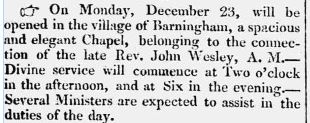
Aspiration and respectability are key concepts in understanding the popular appeal of Evangelical Dissent.  The Nonconformists’ “spacious and elegant” chapels provided their congregations with ‘status by association’ and the fanfare of their opening was frequently reported in the local press:

Bury&Norwich Post, Suffolk, 11Dec 1811

John Betjeman regarded the 19th century chapels as the “true architecture of the people”.  They were paid for through local fund-raising, constructed by local builders and carpenters out of local materials, decorated by local ironmongers and seamstresses, polished and cleaned by humble caretakers and chapel ladies: “not since medieval days had the people clubbed together to adorn a place of worship.”  Moreover, as the 19th century progressed the small insignificant meeting-houses moved from their inauspicious locations in side-streets and alleyways to prominent positions in squares and main streets. New chapels were often elegant, self-confident public buildings, “designed to invite the attention of the passer-by and attract their attendance.”

Class distinctions were not entirely absent in the new Methodist chapels; seating and pews were a structural illustration of social relationships within the congregation.  ‘Spiritual snobbishness’ among the Wesleyans may well have appealed to upwardly-mobile potential recruits. The benevolent societies set up by the Methodists could also reflect class distinctions.  The rules of the Bury St Edmunds Methodist Friendly Society of 1819 mention two classes of benefit: to obtain 1st class benefits a member had to be earning a guinea a week, to receive 2nd class benefits a member must earn at least 16 shillings a week.  These could be afforded by the artisan classes but would certainly have excluded labourers who seldom earned more than twelve shillings a week.

Membership of the Bury Wesleyan Circuit peaked in 1825 with 325 members and by 1851 consisted of just 207 members.  Nationally, it has been estimated that Wesleyan Methodism was embraced by only 8.6% of the nation.  However, the combined forces of Evangelical Dissent were numerically impressive – 24% of people were attending their services in 1851.  Numbers waxed and waned but it is indisputable that the evangelical dissenters not only radically transformed the lives of individuals but completely reshaped the religious landscape of the early 19th century.


Bibliography


Manuscripts:

Suffolk Records Office, (Bury), EE 500/51/70, Rules of the Friendly Society of the Methodist Chapel, St Mary’s Square, 18 Jan. 1819

Websites:
Royal Collection Trust
https://www.royalcollection.org.uk/collection/451114/dinah-morris-preaching-on-the-common

Newspapers and magazines:


Suffolk Record Office, (Bury), Bury and Norwich Post 1800-1900

Books and articles:

Bebbington, D., Evangelicalism in Modern Britain, Routledge, 1988
Brown, Cullum, The Death of Christian Britain, Routledge, 2009
Brown, Richard, Church and State in Modern Britain 1700-1850,Routledge, 1991
Clark, J. C. D., English Society 1660-1832, Cambridge, 2000
Elliott, George, Adam Bede, John Blackwood, 1859
Gilbert, A. D., Religion and Society in Industrial England, Longman, 1976
Groves, Reg., Sharpen the Sickle! The history of the farm workers’ union, Porcupine Press, 1959
Hatcher, S., Primitive Methodists, in Wesley Historical Society (East Anglian District), 108, Summer 2007
Le Faye, D, (ed.), Jane Austen’s Letters, OUP, 1995
Lewis, P., (ed.), Our Chapel, Beamish Open Air Museum, 1991, 31
McLeod, H., Religion and Society in England 1850 – 1914, Macmillan, 1996
Rodell, Jonathan, The Rise of Methodism: a study of Bedfordshire 1736-1851, Boydell, 2014
Thompson, E. P., The Making of the Working Class, Penguin, 1968
Timmins, T.C B. (ed.), Suffolk Returns from the Census of Religious Worship, 1851, Boydell, 1997

Trollope, A., The Vicar of Bullhampton, London, 1870 
Virgoe, N. and Williamson, T. (eds.), Religious Dissent in East Anglia, UEA, 1993
Watts, M., The Dissenters, Vol. II, Oxford, 1995

Suffolk Returns from the Census of Religious Worship, 1851: BURY ST EDMUNDS

The census returns for Bury St Edmund, edited by Timmins, and extracted from his book,

Timmins, T.C B. (ed.), Suffolk Returns from the Census of Religious Worship, 1851, Boydell, 1997

provide a unique sample of mid-19th century religious life in a small county town in West Suffolk.


Three places of worship in Bury St Edmunds were omitted from the Census:

BAPTIST CHAPEL, Westgate Street. Built 1840; there in 1855. 51 members but no stations in 1850

PRIMITIVE METHODIST CIRCUIT CHAPEL, Garland Street.  Opened 22 Jan. 1830.  Sunday services: mornings, afternoons, and evenings.

ST EDMUND'S ROMAN CATHOLIC CHAPEL, Westgate Street.  Chapel built 1838.  Sunday services: Mass 10 a.m.; Prayers, Instruction, and Benediction, 3 p.m.

Timmins also includes details of the provision at Bury St Edmunds County Gaol and House of Correction on Sicklesmere Road, and at the two workhouses but the number of attendees is not mentioned though the officiating chaplains appear to be all Anglicans.